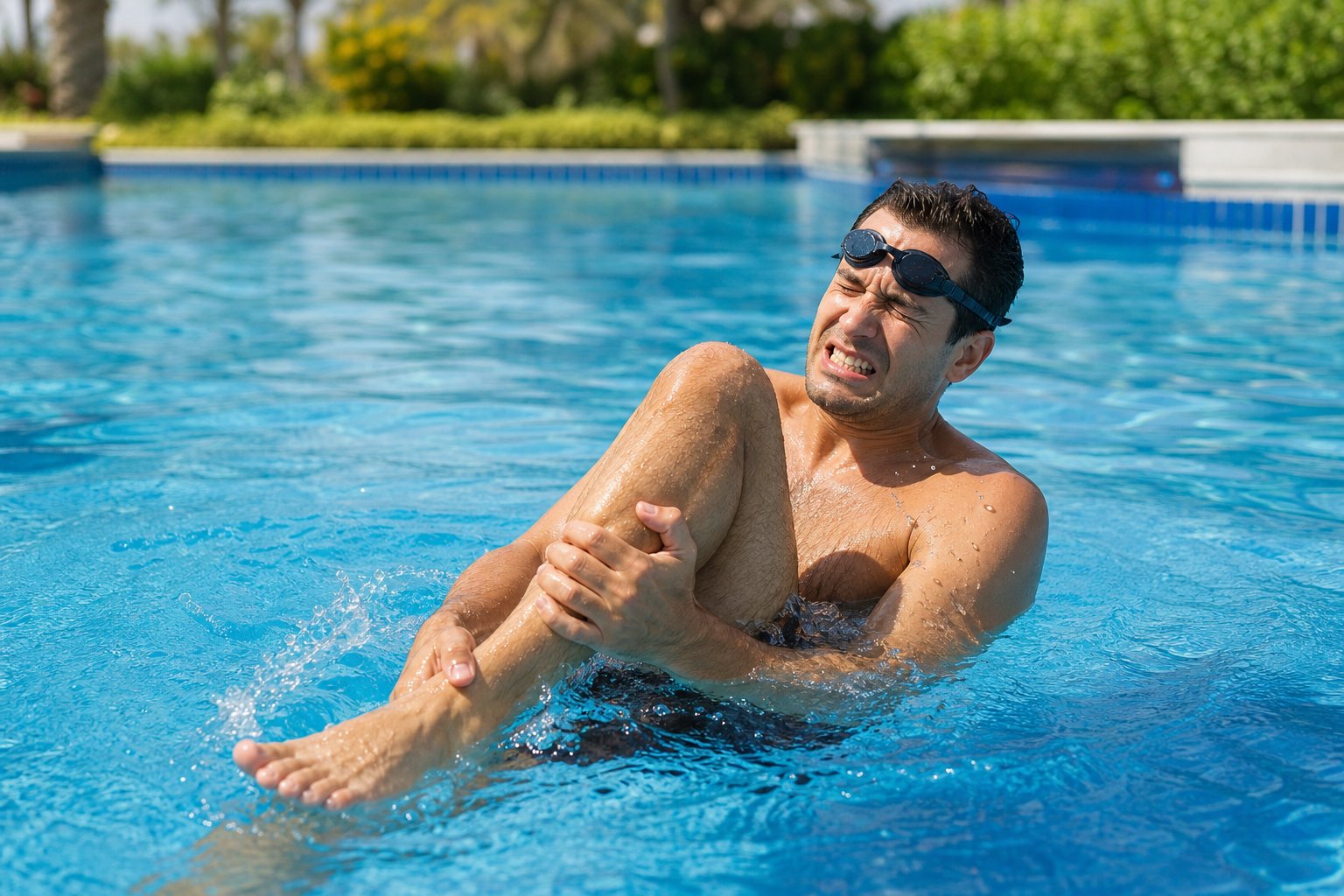
How to Prevent Foot and Calf Cramps While Swimming
Foot and calf cramps can make a swim go from smooth to stressful in seconds, especially if they hit in deep water or during a hard kick set. Most of the time, cramps while swimming come from a mix of muscle fatigue, too much tension through the feet, hydration or electrolyte issues, and technique habits that overload the calves.
If you relax the foot, stretch the cramping muscle, and fix the training or technique pattern behind it, you can usually cut down how often it happens.
At Aim Above Swim School, this shows up often with newer swimmers and returning adults who try to point their toes too hard, kick from the knees, or hold tension through the lower legs. With the right coaching, those patterns are usually very fixable.
What A Cramp In The Water Usually Means
A cramp in the pool is usually a sudden muscle spasm, not just soreness. In swimmers, the foot and calf are common trouble spots because they stay active, elongated, and often tense for long stretches.
Why Foot And Calf Muscles Cramp So Often In Swimming
Your calves and feet work more than many swimmers realize. Even during easy freestyle, you are asking the ankle to stay extended while the foot flicks and stabilizes through every kick.
That becomes a problem when you over-point the toes or stiffen the ankle. I often see swimmers trying so hard to look streamlined that they lock the foot into an aggressive pointed position, and that is when the arch, toes, or calf suddenly seize.
As noted by U.S. Masters Swimming on how swimmers cope with cramps, calf cramps are especially common and may come from multiple factors rather than one single cause.
The Difference Between Fatigue, Tightness, And A True Cramp
Fatigue usually feels like heaviness or loss of power. Tightness feels restricted, like the muscle wants a stretch.
A true cramp is sharper and more sudden. The muscle involuntarily contracts, often hard enough that you have to stop what you are doing immediately.
If you can still keep swimming with mild discomfort, you may be dealing with fatigue or stiffness. If your foot curls or your calf grabs suddenly, that is much more likely a cramp.
When A Cramp May Point To A Medical Issue Instead
Occasional cramps after a hard swim are common. Frequent, severe, or unexplained cramps deserve a closer look.
If your cramps happen outside training, wake you from sleep, occur with swelling or weakness, or keep happening despite better hydration and pacing, speak with a medical professional. Some cramping patterns can relate to medications, circulation issues, nerve irritation, or other health concerns.
The Most Common Triggers During A Swim
Most swimming cramps are not caused by one thing alone. In practice, they tend to show up when tension, fatigue, pool conditions, and hydration all stack together, especially if you already have a history of calf or foot problems.
Over-Pointing The Toes And Excess Tension Through The Feet
This is one of the biggest triggers I see. You want long, loose ankles in the water, not rigid pointed toes.
When you force the point, you shorten the calf and foot muscles while asking them to keep working. That combination can trigger cramps while swimming, especially during flutter kick, backstroke kick, or fin work.
A better cue is to keep your ankle soft and your foot long, not clenched. Think “relaxed flipper,” not “ballet toe.”
Overexertion, Conditioning Gaps, And Hard Kick Sets
Cramps often appear when your body is working past what it is prepared for. That can happen during sprint sets, long continuous swims, or kick-heavy workouts after time away from the pool.
If your calves always cramp near the end of a session, fatigue is likely part of the pattern. According to EatSleepSwimCoach on swimming muscle cramps, the pain can last from seconds to minutes and often affects calves, feet, or toes.
This is common with beginners who try to “muscle through” the water instead of building volume gradually.
Hydration, Sweat Loss, And Electrolyte Balance
You can sweat a lot in the pool without noticing it. That matters because fluid loss and an electrolyte imbalance may contribute to exercise-associated muscle cramps, especially in warm conditions.
Research summarized by U.S. Masters Swimming notes that sweating can reduce sodium and other electrolytes, even during swimming. Plain dehydration is not the full story for everyone, though it is still a major piece of the puzzle.
If you start a swim already under-hydrated, your risk tends to go up.
Cold Water, Warm Pools, And Equipment-Related Stress
Cold water can make muscles feel tighter and less ready to contract smoothly. Warm pools can increase sweat loss, which some swimmers do not expect.
Equipment can add stress too. Fins, especially stiff ones, often increase load through the feet and calves. Pulling hard through a kickboard set can do the same if your ankles are tight or your kick is forced.
What To Do Right Away If It Happens Mid-Swim
Your first job is safety, not finishing the set. If a cramp hits, reduce effort immediately, get stable, and relieve the spasm before deciding whether to continue.
How To Get To A Safe Position In A Pool Or Deep Water
If you are near the wall, stop and hold it right away. Roll onto your back if needed and use a gentle scull with your hands to stay afloat.
In deeper water, stay as calm as possible and avoid rapid kicking. If only one leg is affected, use your arms and the other leg lightly to move toward a wall, lane rope, or shallow area.
If the pain is intense or you feel panicked, signal for help immediately.
Simple Foot And Calf Stretches That Can Ease The Spasm
For a calf cramp, bring your toes up toward your shin. In the pool, that may mean straightening the knee gently and pulling the forefoot back with your hand if you can reach it safely.
For a foot cramp, manually extend the toes and massage the arch lightly. A small amount of stretching usually works better than aggressive pulling.
One thing many swimmers notice is that the cramp eases fastest when you stretch the exact muscle that is seizing. That lines up with observations on quick cramp relief through stretching.
When To Stop The Session Instead Of Pushing Through
Stop if the cramp keeps returning, if your kick feels weak afterward, or if you are in open water or deep water and cannot move normally.
Also stop if the cramp came with dizziness, chest symptoms, or unusual fatigue. A shortened easy swim is far better than turning a manageable problem into a dangerous one.
How To Reduce The Chances Of It Happening Again
Prevention usually works best when you combine better pacing, steady hydration, and stronger lower-leg support. Small changes in your routine can make a big difference within a few weeks.
Pacing, Warm-Ups, And Gradual Training Progression
Start each swim with easy movement, not instant speed. A few relaxed lengths, light kicking, and ankle mobility at the wall can help your lower legs settle into the session.
Build volume slowly, especially if you are returning after time off. If cramps show up during hard kick sets, shorten the repeats, reduce the board work, or alternate kicking with full stroke swimming.
Your body handles consistency better than sudden spikes in intensity.
Daily Hydration And Pre-Swim Fueling Habits
Good hydration starts long before you get on deck. Sip fluids through the day instead of trying to catch up five minutes before swimming.
If you are swimming hard, swimming in a warm pool, or doing a longer workout, include some sodium with meals or choose a drink that supports electrolyte intake when appropriate. As noted in USMS coverage of exercise-associated muscle cramps, too much plain water without enough electrolytes can also be unhelpful for some people.
A light pre-swim snack can help too if you tend to train on an empty tank.
Mobility And Strength Work For Feet, Ankles, And Calves
Tight ankles and weak lower legs make cramping more likely. Simple dryland work helps.
Useful options include:
- calf raises
- bent-knee calf raises for the deeper soleus muscle
- ankle circles
- towel scrunches with your toes
- gentle calf stretching
- foam rolling for the lower leg
What tends to work best is consistency. Two or three short sessions per week usually beats one long mobility session that you forget to repeat.
Why Better Technique Often Leads To Fewer Cramps
When your kick and body position improve, your lower legs stop doing extra work they were never meant to do. Efficient swimming spreads effort more evenly through the whole body and reduces the small, tense movements that often trigger cramps.
How Efficient Kicking Reduces Strain On The Feet And Calves
A good flutter kick is compact, loose, and driven from the hip. Your knees stay soft, your ankles stay mobile, and the foot snaps through the water without being forced.
A poor kick often looks the opposite. The toes are clenched, the knees bend too much, and the swimmer tries to create speed by whipping the lower leg.
That pattern overloads the calves fast. Once you learn to keep the foot relaxed and let the water carry the ankle through the motion, cramping often drops noticeably.
Breathing, Relaxation, And Body Position As Hidden Factors
Many swimmers do not connect breath control to calf cramps, though the link is real. If you hold your breath, lift your head, or tense your whole body when you get tired, your legs usually stiffen too.
That extra tension often travels all the way down to the feet. I have seen swimmers stop cramping simply by improving exhalation, lowering the effort level, and finding a flatter body line.
Relaxed swimming is not lazy swimming. It is efficient swimming.
How Private Coaching Helps Correct Inefficient Movement Patterns
Technique problems are hard to spot from inside your own lane. A coach can usually see right away whether you are over-pointing the toes, kicking from the knees, or carrying unnecessary tension.
That kind of correction matters because cramps are often mechanical as much as physical. According to Aim Above Swim School, private lessons are built around the individual swimmer, which is exactly what helps when your cramping pattern is tied to your specific habits, fears, or movement style.
Where Aim Above Swim School Adds Real Value
The biggest advantage of private instruction is that your cramping issue is treated as a personal movement problem, not a generic swimming complaint. That matters when the real trigger is a mix of fear, tension, ankle stiffness, poor kick timing, or inefficient breathing.
Helping Adult Swimmers Build Comfort Without Excess Tension
Adults often enter the water with more guarded movement than they realize. If you are nervous in deep water or still learning to breathe properly, you may grip through the feet and calves on every length.
Aim Above Swim School works one on one with adult swimmers across the GTA, using a step-by-step approach to build comfort, safety, and efficient technique. That can be especially useful if your cramps appear when anxiety and overexertion combine.
Supporting Children Who Need Skill Progression At Their Own Pace
Children cramp less often than adults, though it still happens when they overkick, tense up, or push beyond their conditioning. Private instruction helps because the pace can be adjusted immediately.
Aim Above Swim School focuses on individualized teaching for children, so your child can improve kicking, breathing, floating, and endurance without being rushed through a group format that does not match their needs.
Private Lessons In GTA Condo And In-Home Pools
A familiar pool setting can make a real difference when tension is part of the problem. Aim Above Swim School offers private lessons by appointment in condo pool locations and in-home pools across Toronto, Etobicoke, Mississauga, North York, Vaughan, Richmond Hill, Brampton, and surrounding areas.
